Understanding Feelings and Emotions: The Circumplex Model Explained
The Difference Between Feelings and Emotions
Before we dive into classification systems, let's clarify an important distinction. While often used interchangeably, feelings and emotions are related but distinct phenomena:
Emotions are physical and instinctive responses to stimuli. They're universal across humans and even many animals—think of the rush of fear when you sense danger or the warmth of love when you see someone you care about.
Feelings are the conscious experience of these emotions. They're your subjective interpretation of what's happening in your body and mind, colored by your personal experiences, memories, and beliefs.
Understanding this distinction is the first step toward greater emotional intelligence. But how do we make sense of the vast spectrum of feelings and emotions we experience?
The Problem with Basic Emotion Labels
Think about the last time someone asked "How are you feeling?"
You probably answered with something simple: "good," "fine," "tired," or "stressed." But these basic labels fail to capture the nuance of human emotional experience.
Consider these questions:
- Is the happiness you feel on a relaxing beach vacation the same as the happiness at an exciting concert?
- Is the sadness of saying goodbye to a friend the same as the sadness of watching a touching movie?
- When you say you're "stressed," are you anxious, overwhelmed, frustrated, or something else entirely?
Basic emotion labels create confusion because they lump together very different experiences. This is where scientific models of emotion become invaluable.
Introducing the Circumplex Model of Affect
The circumplex model of affect is a psychological framework that maps feelings and emotions onto a two-dimensional circular space. Developed by psychologist James Russell in 1980, it's become one of the most influential models for understanding emotional experience.
The Two Dimensions
The circumplex model organizes emotions along two key dimensions:
1. Valence (Pleasure-Displeasure)
This horizontal axis represents how pleasant or unpleasant an emotion feels:
- Pleasant (positive valence): joy, contentment, excitement
- Unpleasant (negative valence): sadness, anger, fear
2. Arousal (Activation)
This vertical axis represents the energy level or intensity of the emotion:
- High arousal: excitement, anxiety, anger
- Low arousal: calmness, depression, relaxation
The Four Quadrants
These two dimensions create four distinct quadrants of emotional experience:
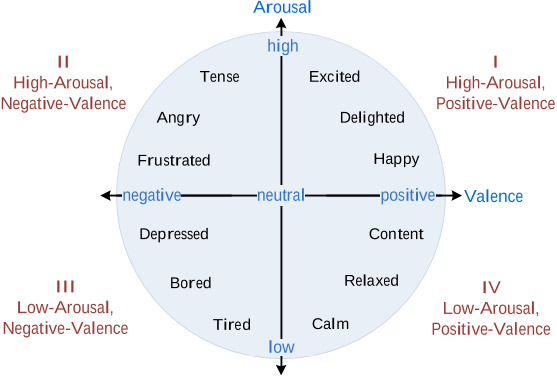
Source: Core emotions established in the circumplex model
This framework explains why "happy" can feel so different in different contexts. The relaxed contentment of a quiet evening (low arousal, pleasant) is fundamentally different from the euphoric excitement of achieving a goal (high arousal, pleasant)—even though both might be labeled "happy."
Why the Circumplex Model Matters for Emotional Intelligence
Understanding the circumplex model transforms how you relate to your feelings and emotions:
1. More Precise Self-Understanding
Instead of vaguely feeling "bad," you can identify that you're experiencing low-arousal negative emotion (perhaps sadness or fatigue) versus high-arousal negative emotion (perhaps anxiety or frustration). This precision helps you respond appropriately.
2. Better Communication
Telling your partner "I'm stressed" could mean many things. But saying "I'm feeling anxious and activated—like I can't relax" conveys something specific that can be addressed.
3. Pattern Recognition
When you track feelings and emotions using the circumplex model, you start to notice patterns:
- Do you tend toward high-arousal states?
- Do you rarely experience low-arousal positive emotions (calm, peaceful)?
- Are your negative emotions mostly high-energy (anxious, angry) or low-energy (sad, depressed)?
4. Emotional Regulation Strategies
Different quadrants require different strategies:
- High arousal, unpleasant: You might need calming techniques (deep breathing, meditation)
- Low arousal, unpleasant: You might need activation strategies (exercise, social engagement)
- High arousal, pleasant: You might want to savor the moment
- Low arousal, pleasant: You might want to appreciate the peace
How Let's Harmonise Uses the Circumplex Model
The Let's Harmonise app was built specifically around the circumplex model of affect, making it easy to capture the nuance of your emotional experience:
Experience Circumplex-Based Emotion Tracking
Let's Harmonise brings the science of the circumplex model to your daily life, helping you understand your feelings and emotions like never before.
Try It FreeIntuitive Emotion Selection
Rather than choosing from a static list of emotion words, Let's Harmonise presents emotions visually organized by valence and arousal. You can quickly identify not just what you're feeling, but how activated that feeling is.
Intensity Levels
Beyond the basic circumplex placement, Let's Harmonise allows you to indicate the intensity of your emotion. This adds another layer of precision to your emotional tracking.
Needs Integration
Emotions aren't random—they point to underlying needs. Let's Harmonise helps you identify what need your current emotion might be signaling:
- Anxiety might point to a need for security
- Loneliness might indicate a need for connection
- Frustration could signal a need for autonomy
Practical Applications of Understanding Feelings and Emotions
In Personal Development
Understanding the circumplex model helps you:
- Set emotional goals (e.g., "I want to experience more low-arousal positive states")
- Identify emotional habits and patterns
- Develop a richer emotional vocabulary
- Practice more effective self-care
In Relationships
When both partners understand feelings and emotions through this framework:
- Communication becomes more precise and effective
- Misunderstandings decrease
- Empathy becomes easier
- Conflict resolution improves
In Mental Health
Mental health professionals increasingly use the circumplex model:
- It helps clients articulate their experiences more precisely
- It provides a framework for tracking treatment progress
- It normalizes the complexity of emotional experience
- It guides intervention selection
In the Workplace
Emotional intelligence is increasingly recognized as crucial for professional success:
- Leaders who understand emotions communicate more effectively
- Teams with emotional awareness collaborate better
- Stress and burnout can be identified earlier
- Work satisfaction improves when emotions are understood and addressed
Beyond the Circumplex: Other Emotion Models
While the circumplex model is powerful, other frameworks exist:
Basic Emotion Theory (Ekman)
Paul Ekman's model identifies six universal basic emotions: happiness, sadness, fear, anger, surprise, and disgust. While simpler, this model doesn't capture the nuance of emotional intensity.
Plutchik's Wheel of Emotions
Robert Plutchik proposed eight primary emotions arranged in a wheel, with combinations creating secondary emotions. This model emphasizes how emotions blend and intensify.
The Circumplex Advantage
The circumplex model offers unique advantages:
- It's dimensional rather than categorical, capturing subtle variations
- It's backed by extensive psychological research
- It's intuitive and easy to use once understood
- It maps well to physiological measures of emotion
Developing Your Emotional Vocabulary
One of the greatest benefits of understanding the circumplex model is developing a richer emotional vocabulary. Instead of "good" or "bad," you can describe:
High arousal, pleasant:
- Exhilarated, elated, enthusiastic, excited, stimulated, energized, thrilled
Low arousal, pleasant:
- Serene, peaceful, calm, content, satisfied, relaxed, comfortable, at ease
High arousal, unpleasant:
- Anxious, nervous, stressed, agitated, frustrated, angry, irritated, overwhelmed
Low arousal, unpleasant:
- Sad, melancholic, depressed, fatigued, drained, bored, apathetic, lonely
This expanded vocabulary leads to better self-understanding and communication.
Start Understanding Your Feelings and Emotions Better
The circumplex model isn't just academic theory—it's a practical tool for everyday emotional intelligence. By understanding where your feelings and emotions fall on the dimensions of valence and arousal, you gain:
- Greater self-awareness
- Better emotional communication
- More effective coping strategies
- Deeper connections with others
Let's Harmonise brings this scientific framework to your daily life, making it easy to track, understand, and communicate your emotional experience.
Ready to understand your feelings and emotions at a deeper level? Join Let's Harmonise and experience circumplex-based emotion tracking today.
Start Your Journey Today
Join Let's Harmonise and discover a better way to understand yourself and connect with others.
Join Beta